Selective activation
Neural units are activated according to the active context, concentrating computation where it is required.
 Return to platform
SOVEREIGN AI ARCHITECTURE / RRSC
A proposal to reinvent the computing substrate beneath artificial intelligence through a Hybrid-Sparse-Temporal architecture, adaptive neural activation and a sovereign security perimeter.
AURYNTHEON OFFICIAL FILM / 2026
An official visual presentation of the programme’s sovereign computing vision, intelligence architecture and future operating environment.
PROGRAMME OVERVIEW / 01
AURYNTHEON is conceived as a hardware-and-software architecture designed from first principles. Its central thesis is to move beyond dense, always-active computation by selecting the pathways and experts required by each context.
HYBRID-SPARSE-TEMPORAL INTELLIGENCE / 02
Four interdependent principles define the proposed intelligence layer. Each card describes an architectural direction, not yet a validated performance result.
Neural units are activated according to the active context, concentrating computation where it is required.
The HST proposal is designed to carry structured inference across temporal states instead of relying only on broad brute-force processing.
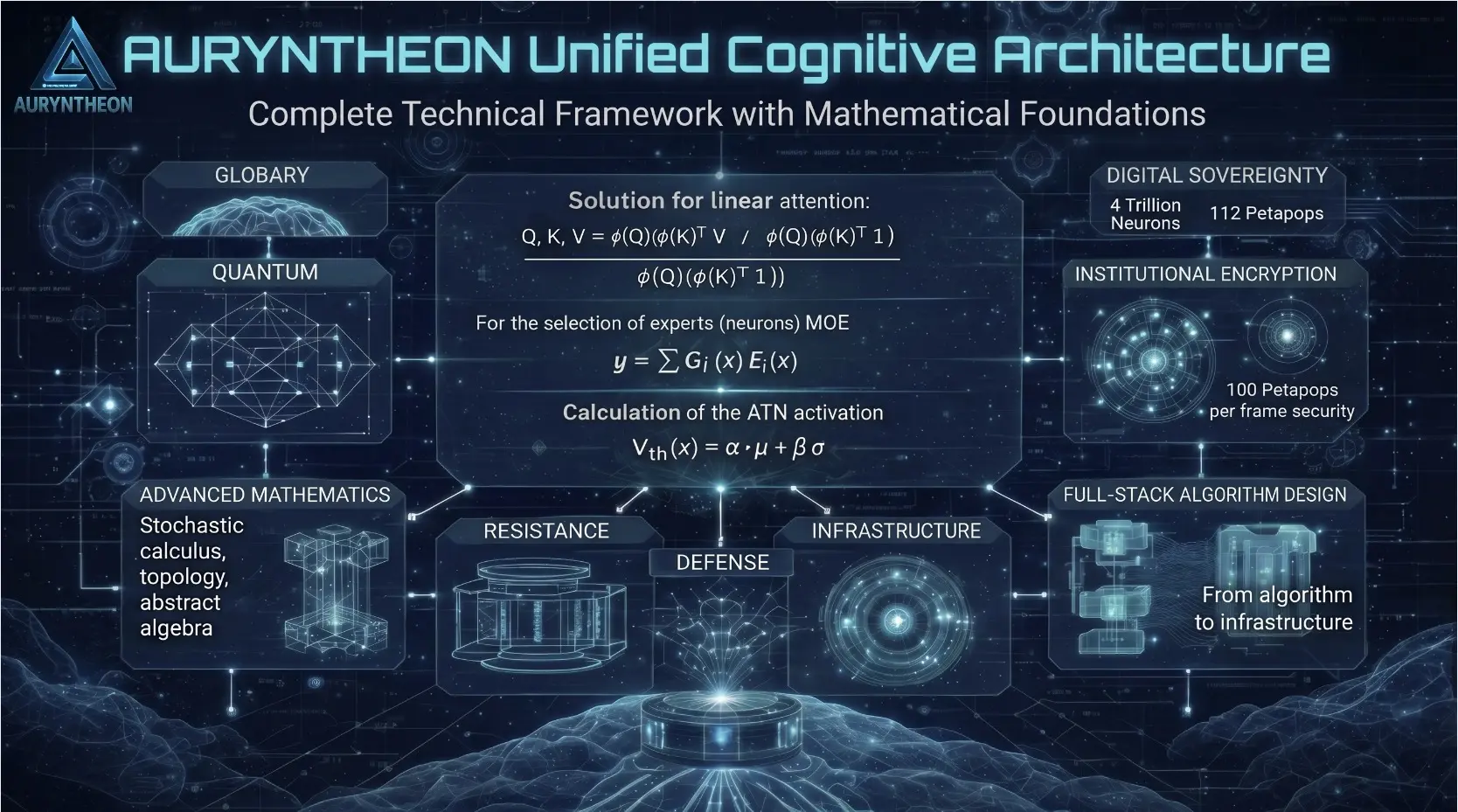
Adaptive Threshold Neurons are designed to regulate activation according to context, hierarchy and signal relevance.
The C-SVA concept routes signals according to predicted need, supporting sparse, event-driven computation.

SOVEREIGN SECURITY PERIMETER / 03
The programme describes a multilayer security model around the neural core. Its implementation and post-quantum claims remain part of the programme’s future technical validation.
A proposed multilayer cryptographic boundary around internal components and data paths.
Isolation of the core intelligence layer is intended to reduce exposed attack surfaces.
Independent protection layers are designed across interfaces, subsystems and operational boundaries.
Every external interaction is treated as untrusted until it is explicitly verified.
STRATEGIC APPLICATION FIELDS / 04
The programme is positioned as a general computing layer, while the Group’s current teams also design end-to-end AI software independently of the future ASIC programme.
AI systems, models and production software designed from first principles for specific operating requirements.
Intelligent automation, condition monitoring and decision support for industrial environments.
Computational intelligence for energy systems, infrastructure efficiency and resilient operations.
Research-oriented intelligence for complex scientific analysis and future discovery workflows.
Advanced modelling, scientific computing and specialist engineering decision environments.
Sovereign, edge and multi-domain intelligence concepts for high-resilience operational contexts.

CURRENT PROGRAMME STATUS / 05
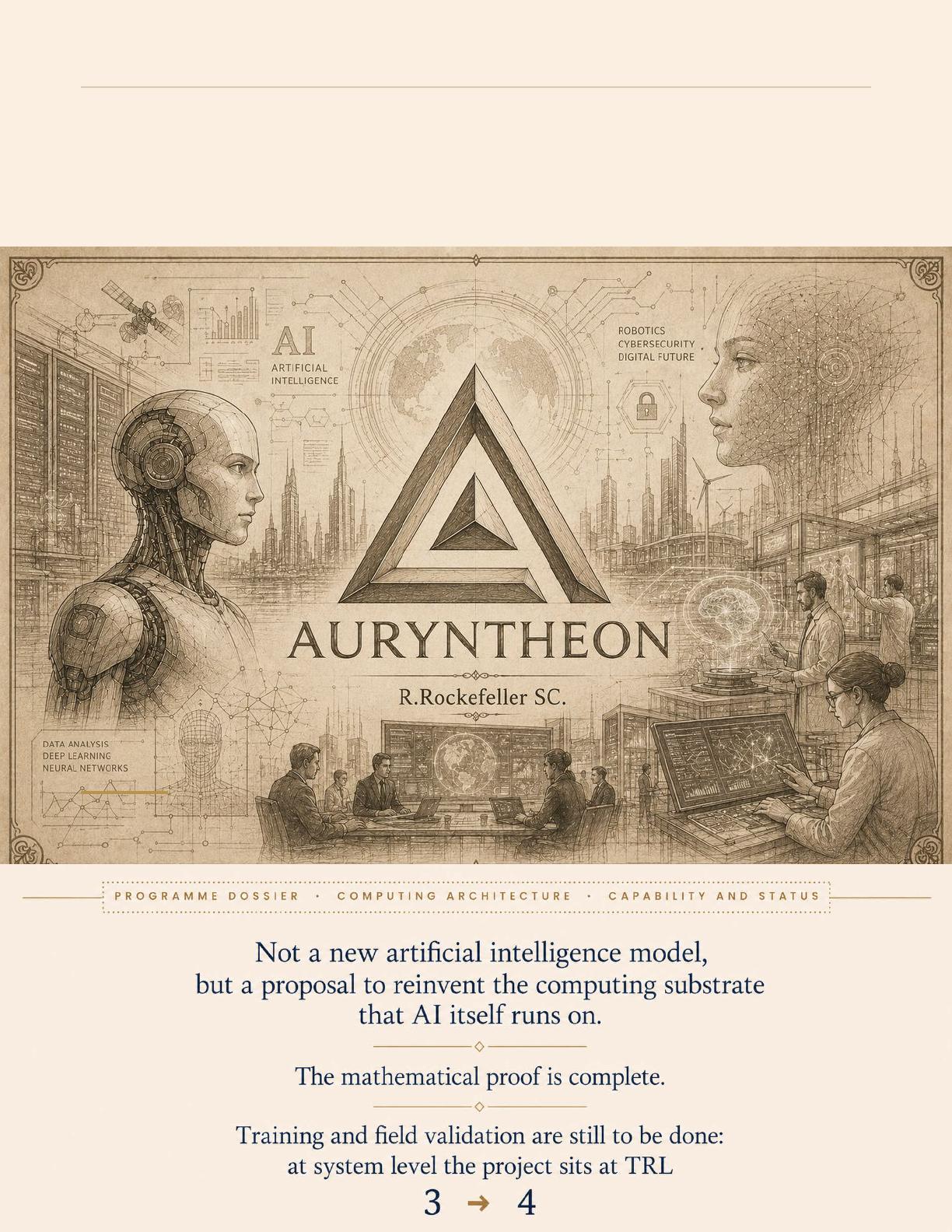
The v6.1 dossier separates completed analytical work from experimental validation. This is the programme’s current development ladder.
The mathematical framework and principal component designs are described as complete and internally consistent.
A laboratory-scale experiment is in progress to test the architecture and move the programme from TRL 3 toward TRL 4.
Full training, benchmarking, independent technical review and an ASIC prototype remain future validation gates.
Energy-efficiency and scaling figures remain design targets until they are measured through training, benchmarking and real hardware.
PROGRAMME VISUAL ARCHIVE / 06
These images communicate the programme’s intended direction. Their embedded figures and scenarios are conceptual; the v6.1 dossier is the authoritative current-status reference.
OFFICIAL DOCUMENTS / 07
 DOC / 01
The current programme document: technical thesis, validation ladder, maturity, risk, specifications and execution framework.
 DOC / 02
The official visual presentation of the proposed architecture, intelligence layer, security model and application domains.
 DOC / 03
The official business-plan document covering programme direction, market framework and planned development path.
 DOC / 04
The official research document setting out the conceptual foundations behind the HST, ATN and C-SVA approach.
PROGRAMME DECLARATION / 08
AURYNTHEON is a long-horizon programme for a sovereign AI computing layer. Its ambition is presented together with the validation still required—because credibility begins by distinguishing architecture from demonstrated performance.
Read the current programme dossier